Thoracic Spine
Upper back mobility, rotation, extension, and posture work to address the primary mobility limitation and improve overhead movement quality.
Thoracic spine mobility is the highest-priority mobility target in Atlas. The upper back tends to stiffen with desk work, bench pressing, and anterior-dominant training. Restoring thoracic mobility improves overhead position, breathing mechanics, and running posture.
Assessment
Before beginning, assess your current thoracic mobility.
Quick Self-Check
- Sit in a chair with knees together
- Cross arms over chest
- Rotate to each side without leaning
Pass: You can rotate approximately 45–50° to each side without the hips turning. Fail (common): Rotation is limited to ~30° or the hips turn with the trunk to create the illusion of rotation.
Thoracic rotation is part of normal running mechanics; the upper body counter-rotates against the lower body with each stride. Limited thoracic mobility forces compensation at the lumbar spine (which is not designed for significant rotation), increasing lower back stress during running.
The Daily Routine
Perform these exercises daily. Total time: approximately 3–5 minutes.
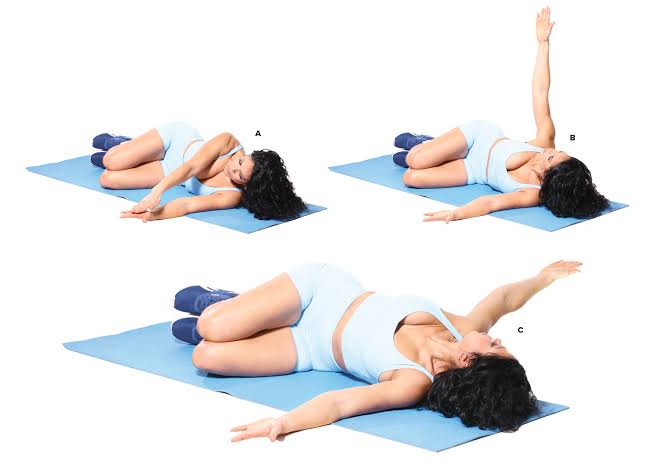
1. Thoracic Rotation (Bench or Floor)
- Position
- Side-lying, knees bent to 90°, arms extended forward
- Movement
- Open the top arm like a book, rotating through the upper back
- Hold
- 2–3 seconds at end range
- Reps
- 8–10 per side
- Breathing
- Exhale during rotation; inhale on return
2. Thoracic Extension Over Foam Roller
- Position
- Foam roller placed horizontally under upper back
- Movement
- Extend over the roller, supporting head with hands
- Hold
- 30–60 seconds, breathing deeply
- Progression
- Move roller up or down one vertebra at a time
3. Thread the Needle
- Position
- All-fours position
- Movement
- Thread one arm under the body, rotating through the upper back
- Hold
- 2–3 seconds at end range
- Reps
- 8–10 per side
4. Wall Slides
- Position
- Standing with back against wall, arms in "stick-up" position
- Movement
- Slide arms up the wall while maintaining wrist and elbow contact
- Reps
- 8–10 slow repetitions
Thoracic mobility responds well to frequency. Two minutes daily produces better results than ten minutes twice per week. The tissues need consistent, gentle exposure to end-range positions, not infrequent, aggressive stretching.
Common Mistakes
Rotating Through the Lower Back
The lumbar spine is not designed for significant rotation. If your hips turn during thoracic rotation exercises, reduce the range of motion and focus on isolating movement to the upper back.
Holding Breath
Thoracic mobility and breathing mechanics are closely linked. Exhaling during rotation or extension facilitates greater range of motion. Holding breath limits range and reinforces tension patterns.
Aggressive Stretching
Thoracic stiffness is partly structural (rib cage attachments limit extreme mobility) and partly habitual (postural adaptation over years). Aggressive stretching is counterproductive; it triggers protective muscle guarding. Gentle, consistent exposure to end-range positions is more effective.
The thoracic spine is naturally less mobile than the cervical spine (neck) but more mobile than the lumbar spine (lower back). Its primary motions are rotation and extension. Desk work and anterior-dominant training (bench press, shoulder press) create a flexion-biased posture that reduces thoracic extension over time. Mobility work restores the spine's natural capacity for extension and rotation; it does not create "extra" range beyond what the joint structure allows.
Integration
- Daily: 3–5 minutes of the routine above
- Pre-gym: Include thoracic rotation and wall slides in warm-up
- Pre-run: Brief thoracic rotation to improve upper body movement during running
- Desk breaks: Thread the needle or seated rotation every 2–3 hours